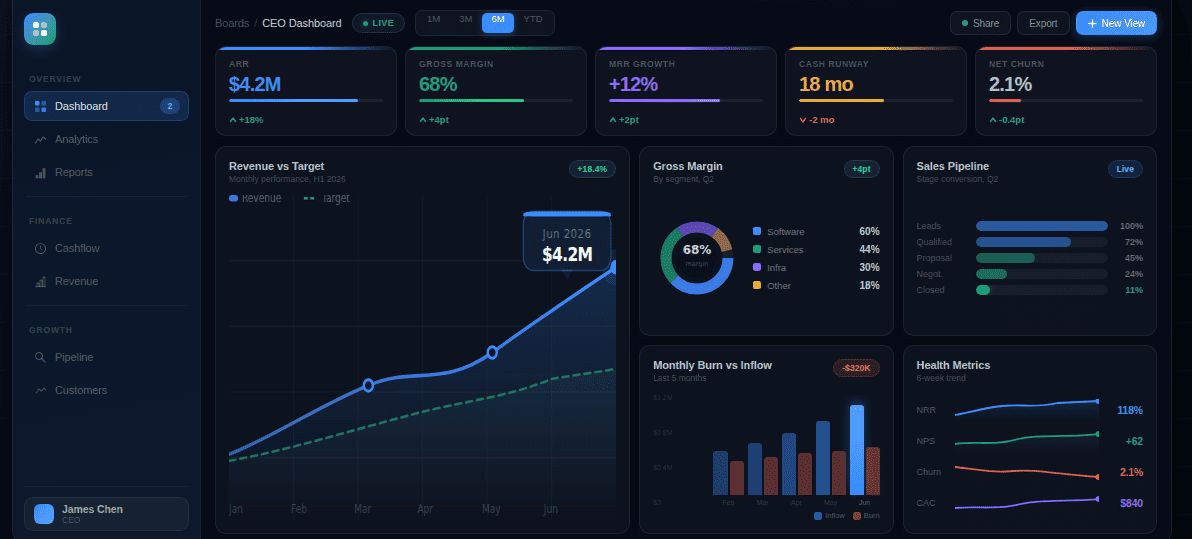
A CEO dashboard is a single-view tool that consolidates a company's most critical metrics, typically 8 to 12 KPIs across revenue, profitability, customers, and operations, to support weekly leadership decisions. But the right metrics change by company stage. A $2M ARR founder needs a different dashboard than a $50M ARR scale-up CEO. This guide covers what belongs on yours at each stage.
Why most CEO dashboards fail
The template is familiar: twenty or so metrics, four neat categories, the same dashboard for every company. The shape isn't wrong. The assumption behind it is. A company with twelve customers and a company with twelve hundred have almost nothing in common, and a dashboard built to serve both serves neither well.
Four failure modes show up consistently.
The first is using a dashboard built for the wrong stage. A founder still watching time-to-first-value at $30M ARR is tracking a question the company answered years ago. The metric was useful at $500K; at $30M, what matters is pipeline coverage and burn multiple. Mismatches like this go uncorrected for quarters because nobody wants to be the one to point out that the dashboard is measuring the wrong things.
The second is too many metrics and too few decisions. A dashboard with 22 KPIs is a report. A dashboard with 8 KPIs and clear thresholds is a decision tool. Every row should pass a test: if it moved twenty percent overnight, would somebody pick up the phone? If the honest answer is no, the row doesn't belong.
The third is leaning entirely on lagging indicators. Revenue, gross margin, and churn tell the team what already happened. Pipeline coverage, activation, voluntary attrition tell them what's coming. A dashboard heavy on lagging metrics forces the team to react to history instead of steering.
The fourth and fifth are operational. Every metric needs a name next to it (a person, not a department), or nobody moves the number. And the dashboard needs a calendar to go with it. Reviewed monthly, it becomes a monthly report by default. Reviewed weekly with the same agenda in the same order, it becomes an operating cadence. Most companies build the dashboard and never build the calendar, then wonder why it fades from use after six weeks.
How the dashboard changes by stage
Founder stage ($0 to $1M ARR): is the product working?
At founder stage the CEO is not really running a business. The job is to figure out whether the product solves a real problem for a specific kind of customer, and the dashboard exists to answer that question.
Five metrics that belong:
- Weekly active accounts. For B2B, accounts with at least one engaged user in the last seven days. This is the closest you can get to "is the product working" before you have enough revenue for revenue metrics to be meaningful.
- Activation rate. Percentage of new signups that complete the first valuable action. Define that action narrowly. "Uploaded a file and saved a dashboard" is a clear activation event. "Logged in" is not.
- Time to first value (TTFV). Median time from signup to first activation event. The absolute number matters less than the direction it's moving.
- 30-day retention. Of the users who activate, what percentage come back in week four. Anything below 40 percent means the product is leaking faster than acquisition can refill it.
- Cash runway in months. Net burn divided by current cash. Below six months, raise or cut. Below nine months, the next round needs to already be in motion.
Three metrics that look CEO-worthy at founder stage but don't belong:
- ARR. Too small and too volatile to inform decisions. A single customer signing or churning can swing it eight percent in a week.
- NPS. The sample is too small to be statistically meaningful, and at this stage your respondents are early adopters who will rate everything generously.
- CAC. If paid acquisition is the focus before product-market fit, the dashboard is hiding a strategy mistake rather than measuring one.
Cadence: Daily check on activation and retention by the founder and one other person. Weekly review with the leadership team if there is one yet.
Example. A pre-Series A B2B SaaS at $400K ARR, twelve paying customers, eleven months of runway, activation at 34 percent, 30-day retention at 51 percent. Activation had been flat for six weeks. The founder's first hypothesis was that the homepage was the problem (too many use cases, not enough clarity), and the team spent two weeks rewriting it. Activation didn't move. The actual cause was earlier in the funnel: the trial signup required four fields including company size, and mid-market evaluators who answered honestly with "10,000+" never came back because they assumed the product wasn't built for them. Reducing the signup to two fields moved activation from 34 to 47 percent in three weeks. The homepage rewrite was fine, it just wasn't the bottleneck.
Early-stage ($1M to $10M ARR): are we building a real business?
The product works. The question now is whether the unit economics hold up as the company gets bigger.
Five metrics that belong:
- Net new ARR (weekly). New plus expansion minus churn minus contraction. At this stage it's the heartbeat number, and the weekly cadence matters because monthly numbers hide the wobble.
- Gross margin. Benchmarks vary by industry: roughly 70 percent and up for B2B SaaS, 40 to 60 percent for professional services, 25 to 45 percent for manufacturing. If you're sitting below the benchmark for your industry, that's a CEO-level problem, not a finance one.
- CAC payback period. Months of gross margin from a new customer required to repay the cost of acquiring them. Under 12 months is healthy for B2B SaaS. Past 18, the model usually needs adjustment somewhere.
- Logo churn (monthly). Customers churned divided by customers at month start. The level matters less than the trend. Three consecutive months of climb is when the CEO needs to look at it directly.
- Cash runway in months. Same metric as founder stage, but the calculation gets more demanding. At $5M ARR you have to include hiring plans and known commitments, not just last quarter's burn rate.
Three metrics that look CEO-worthy at early-stage but don't belong:
- Net Revenue Retention (NRR). The headline metric of scale-up SaaS, but at $3M ARR the expansion data is too thin to read clearly. Track it for the trend, don't make decisions on the level yet.
- Rule of 40. Composite metrics need stable inputs. At this stage both growth rate and margin are too volatile for the composite to tell anyone anything actionable.
- Department-level OKR progress. That belongs on the leadership team's dashboard. The CEO sees outcomes; the leadership team sees the activity behind those outcomes.
Cadence: Weekly leadership meeting with the five numbers on a shared screen. Red, amber, or green against thresholds set at the start of the quarter. Red for two weeks running triggers a structured response: owner, root cause, countermeasure, due date.
Example. An $8M ARR Series A SaaS, 78 percent gross margin, 14 months of runway, CAC payback at 11 months, logo churn at 1.8 percent monthly. Last week's review surfaced a problem: net new ARR slipped from $180K the week before to $140K, but pipeline coverage looked unchanged. The cause was a customer that had been quietly contracting and nobody had flagged. The response was a weekly contraction review owned by customer success.
Scale-up ($10M to $50M ARR): are we building it sustainably?
This is the stage where most CEO dashboards stop working without anyone noticing. The metrics that drove the company from $1M to $10M still get tracked out of habit, but they no longer inform CEO-level decisions. The bottleneck has moved somewhere else, and the dashboard hasn't moved with it.
Five metrics that belong:
- ARR with growth rate. Absolute ARR and year-over-year growth, side by side. Both go on the dashboard because investors and the board will ask for both, and the CEO should never be reading either of them for the first time in a meeting.
- Net Revenue Retention (NRR). Meaningful now in a way it wasn't a year ago. The single number that captures whether the existing customer base is a growth engine or a leaky bucket. Above 110 percent is healthy in B2B SaaS. Above 130 is genuinely good. Anything under 100 means the company is acquiring out of a hole.
- Pipeline coverage. Next-quarter qualified pipeline divided by next-quarter target ARR. Anything under 3x in B2B SaaS is a problem, and the CEO needs to be seeing it before the sales leader brings it up.
- Burn multiple. Net burn divided by net new ARR. Under 1.5 is good. Above 2.5 is concerning. Above 3, the growth being purchased is uneconomic. This is the most useful single metric at scale-up, and most boards still under-weight it. They anchor on growth rate, which is how companies end up at 40 percent growth with a burn multiple of 4 and a board that thinks the company is winning.
- Gross retention. Logo or revenue retention before any expansion is counted. Worth tracking separately from NRR because expansion can mask churn for several quarters. 90 percent gross retention with 130 percent NRR is durable. 75 percent gross retention with 130 percent NRR is fragile, even though the headline looks identical.
Three metrics that look CEO-worthy at scale-up but don't belong:
- Weekly active users. Useful to the product team. Not useful to the CEO. If WAU declines materially, NRR and gross retention will catch it within sixty days.
- Time to first value. Product management territory. The head of product owns it.
- Individual rep quota attainment. Belongs to the sales leader. The CEO sees pipeline coverage and net new ARR; the rep-level detail is one level down.
Cadence: Weekly operating cadence, same time on the calendar every week, same agenda. Five numbers first, then the priority for the week, then escalations. Forty-five minutes is the cap.
Example. A $32M ARR vertical SaaS, NRR at 142 percent, pipeline coverage at 3.4x, burn multiple at 1.2, gross retention at 88 percent. The conversation was about gross retention sliding from 91 to 88 over two quarters. The CS team's first hypothesis was that competitive losses were driving it, and they spent three weeks scoping a win-loss program before anyone bothered to look at the churn cohort by acquisition year. When someone finally did, the story changed: every percentage point of the decline traced back to a single segment that had bought during a 2024 pricing experiment and was now churning at roughly three times the rate of other segments. The win-loss program got shelved. The save program that actually moved the number was owned by the head of customer success and targeted only that 2024 cohort.
Mature ($50M+ ARR): are we building it efficiently?
The question shifts at this stage. Growth alone no longer carries the story; the dashboard has to expose where the business creates value and where it leaks.
Five metrics that belong:
- Rule of 40. Growth rate plus free cash flow margin. The summary metric of SaaS health at scale. Above 40 is the public-company benchmark. Above 60 is genuinely exceptional.
- Contribution margin by segment. Revenue minus direct cost, broken down by customer segment, product line, or geography. At this stage the CEO's job is reallocation, and this is the metric that drives it.
- NRR with cohort decomposition. Not just the headline figure but the split by acquisition cohort, segment, and product. Composition matters more than the level. 120 percent NRR carried entirely by one enterprise cohort is a different business from 120 percent NRR distributed across the base.
- Magic Number. Net new ARR for the quarter divided by sales and marketing spend in the prior quarter. The sales efficiency number investors will be watching, which means the CEO should be watching it first.
- Revenue per employee. A leading indicator of operating leverage. If this trends down, the company is hiring faster than it's growing, and that's a problem only the CEO can fix. The way this metric gets misused at mature stage is as a competitive benchmark, comparing your revenue per employee to a competitor's or an industry median. That comparison is almost always misleading because revenue per employee is a function of pricing model, sales motion, and offshoring strategy, not productivity. Use it as a velocity check on your own trend, not as a yardstick against someone else's.
Three metrics that look CEO-worthy at mature stage but don't belong:
- Activation rate. A product-led growth team metric. By $50M+ ARR the CEO needs to trust the PM team to monitor it without putting it on the executive dashboard.
- Daily cash position. A CFO number. The CEO sees runway and Rule of 40; the CFO owns the daily cash file and escalates if anything looks unusual.
- NPS as a snapshot. A single quarterly score is too noisy to inform action. NPS as a trend across six quarters, segmented by cohort, is sometimes useful, but at that point it belongs in a customer health view, not the CEO dashboard.
Cadence: Weekly review of the five numbers, plus a monthly segment deep-dive where contribution margin and NRR cohorts get looked at in detail. Weekly handles "is anything off track this week." Monthly handles "where do we move the next dollar."
Example. A $120M ARR company on a public-track timeline, Rule of 40 at 52 (32 percent growth, 20 percent FCF margin), NRR at 118 percent, Magic Number at 1.1, revenue per employee at $340K. The recent conversation was about a segment showing 140 percent NRR but contribution margin running twelve points below the company average. Finance's first recommendation was a 12 percent price increase across the segment at next renewal. The board liked it. The CRO didn't, and not because of the math: the segment included three of the company's five reference customers, and a heavy-handed increase risked the references right before a public roadshow. The CEO ended up at a 7 percent increase paired with expanded onboarding for new logos in the segment, accepting two more quarters of lower margin in exchange for protecting the references. Not the cleanest answer, but the right one given the timing.
What to leave off every CEO dashboard
Some metrics fail at every stage. They look like CEO material but almost never earn the slot.
Vanity revenue without margin context. A 40 percent growth rate at 12 percent gross margin describes a worse business than a 25 percent growth rate at 78 percent gross margin. If revenue goes on the dashboard, gross margin sits next to it.
Engagement metrics divorced from outcomes. Logins, page views, session counts, feature adoption. These are inputs to retention, not outcomes. The CEO-level question is "did engagement translate to retention this quarter," and the answer is gross retention.
Department-level operational metrics. Pipeline by source, conversion by funnel stage, ticket volume by category. Leadership team metrics, not CEO metrics. The CEO sees the outcome (pipeline coverage, customer satisfaction trend); the leadership team works the detail behind it.
Forecast variance without commentary. A bare percentage off forecast tells the CEO nothing. "Sales came in six percent below forecast because two enterprise deals slipped from Q3 to Q4 and one churned post-renewal" tells the CEO what to do next. If the variance shows up, the commentary shows up next to it.
NPS as a snapshot. A single quarterly score is statistically noisy. The sample is usually too small to draw conclusions, and the benchmarks shift depending on the comparison set. Trended NPS across six quarters, segmented by cohort, is occasionally useful. The snapshot rarely is.
Anything without a named owner. If a metric goes red and nobody on the call can say who's responsible for moving it, the metric shouldn't be on the dashboard in the first place.
Building the weekly cadence
Most CEO dashboard reviews are run as a single weekly meeting. In practice, the week needs three short touchpoints, and most weekly reviews fail because they try to do all three jobs in one sitting.
Monday morning. Twenty minutes, leading indicators only. Pipeline coverage, activation, voluntary attrition, hiring pipeline. The question is "what's coming this week." Lagging metrics are excluded; they'll get reviewed on Friday. Monday sets the priority of the week before anything else happens.
Wednesday afternoon. Fifteen minutes, progress on Monday's priority. The intervention picked on Monday (a pipeline gap, a churn spike, a hiring blocker) gets checked at the midpoint. Is it working? Does anything need to change? Wednesday is the meeting most companies skip, and it's the one that matters most. Without it, Monday's priority quietly drifts.
Friday end of day. Thirty minutes, lagging confirmation and prep for next week. Net new ARR, gross margin, churn, runway. The question is "what actually happened." Anything red gets an owner, a root cause, and a countermeasure with a due date. The meeting ends with next Monday's priority written down in one sentence, owned by name.
The split matters because the three questions the CEO has to answer every week (what's coming, what's happening, what just happened) compete for attention when crammed into one sixty-minute review. Splitting them keeps each meeting tight. The cadence is also where the data storytelling happens, which is what turns a dashboard into an operating system rather than a screen.
CEO dashboard vs CFO dashboard
These two artifacts get conflated and shouldn't be. A CEO dashboard answers "is the business on track this week," with five to twelve metrics across revenue, retention, efficiency, and forward indicators, reviewed weekly with the leadership team. A CFO dashboard answers "is the business financially controlled this month," with detailed views of revenue recognition, gross margin by line, AR aging, cash, covenant compliance, and forecast variance, reviewed monthly with the board. The overlap is gross margin and runway. Everything else goes ten levels deeper on the CFO side.
Choosing the tooling
At founder stage, CEO dashboard software isn't really necessary. A Google Sheet works, and the discipline of looking at the same five numbers every week matters more than the visualization. At early-stage the Sheet breaks: too many tabs, too many manual updates, too many sources. A dedicated dashboard tool earns its keep here. The criteria are integration coverage with the source systems already in use, refresh reliability, and readability for the non-analysts on the leadership team.
At scale-up and mature, real-time refresh stops being a nice-to-have. By $20M+ ARR the cost of a stale number is measured in days of delayed decisions. The right CEO dashboards solution at this stage handles real-time pipeline, real-time cash, and segmented views without forcing the analytics team to rebuild every quarter.
A handful of platforms, Fusedash among them, are designed to carry a company through all four stages without forcing a migration. The criterion that matters most over time is whether the dashboard can evolve in place as the metrics on it change.
Where to start
The standard advice for a broken CEO dashboard is to rebuild it. That's usually the wrong move. The dashboard isn't broken in isolation. It's broken because the company moved and the dashboard didn't, which means a rebuild will be wrong again in two quarters unless the underlying question gets fixed first.
The faster diagnostic is to pull up your current dashboard in your next leadership meeting and ask one question: which of these rows would you not notice if they disappeared for a month. The metrics nobody would miss are the ones to cut. What's left tells you which stage the dashboard is actually built for, and the gap between that and where the company is now is the real problem to solve.
Fusedash builds executive dashboards that evolve as the metrics on them change, from the five-number founder view to the segmented scale-up cockpit, without rebuilding at each transition. Deciding which metrics actually belong is the harder part of the job, and it's the part only you can do.